


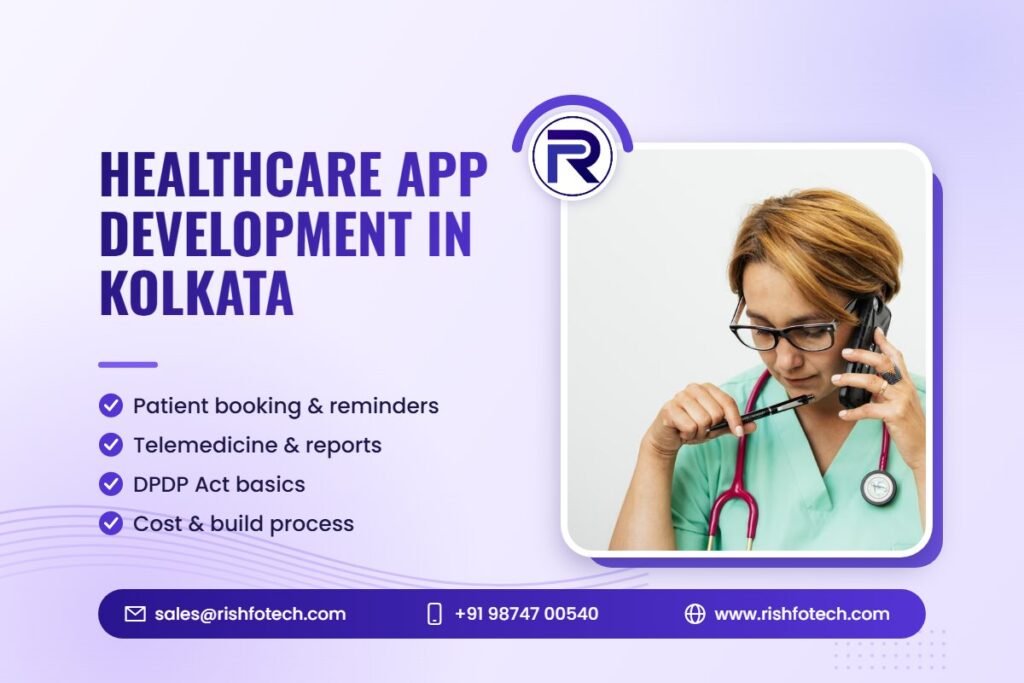
A typical call we get from a clinic owner goes like this. The front desk spends half the morning on the phone, booking and rebooking patients, and reports still go out on paper. The owner does not really want “an app”. They want fewer calls and happier patients. If you are looking for a healthcare app development company in Kolkata, that is usually the real brief. This guide covers the features that matter for clinics, hospitals and diagnostic centres, what a healthcare app or website costs in 2026, how the build works, and what India’s data protection law means for you.
Short answer: most clinics should start with a fast website plus online booking and WhatsApp reminders. Hospitals and diagnostic chains usually need a patient app, a doctor/staff panel and an admin dashboard tied to their existing billing or lab system. Below is how to decide.
App or website first? What healthcare businesses in Kolkata actually need
Many people searching for healthcare website development in Kolkata end up asking for an app, and the other way round. They are different tools.
- A website is how new patients find you. It ranks on Google, shows your doctors, timings, services and location, and takes bookings. Every clinic needs one.
- A mobile app is for patients who come back again and again. Think follow-ups, repeat lab tests, chronic care, family health records. It makes sense when you already have a steady patient base.
- A web app or portal sits in between. Patients log in from the browser to see reports and bookings, without installing anything. For many diagnostic centres this is the sweet spot.
A single-doctor clinic in Behala does not need the same thing as a 200-bed hospital in EM Bypass. On most projects we build, we start with the website and booking flow, then add the app once the clinic knows what patients actually use.
Must-have features for healthcare apps and websites
These are the features clients ask us for most, and the ones that save real staff time.
1. Online appointment booking
This is the core feature. Patients pick a doctor, a department or a test, see free slots and confirm. Good booking systems handle doctor leave, slot length per doctor, walk-in buffers and multiple branches. The admin side should let your front desk move or cancel bookings in two clicks. If your doctors sit at different clinics on different days, the system must know that too.
2. WhatsApp and SMS reminders
In Kolkata, patients read WhatsApp. They often ignore email. Automatic reminders a day before and a couple of hours before the visit cut no-shows a lot. We connect this through the official WhatsApp Business API, with approved message templates for booking confirmation, reminder, report ready and payment link. SMS stays as a backup for patients without WhatsApp.
3. Teleconsultation (video calls)
Video consults are now normal for follow-ups and second opinions. The doctor joins from the panel, the patient joins from the app or a link, and the call is tied to the booking. Keep it simple: no extra downloads for the patient, a waiting room, and a fallback to audio when the network is weak. Doctors in India also need to follow the Telemedicine Practice Guidelines, so the flow should capture patient consent and identity before the call.
4. E-prescriptions
After a consult, the doctor fills a short form with medicines, dosage and advice. The system creates a clean PDF with the doctor’s name, registration number and clinic details, and sends it to the patient. Saved medicine lists and templates make this fast. Patients like it because they can show it at any pharmacy from their phone.
5. Lab reports online
For diagnostic centres this is the biggest win. Reports get uploaded (or pulled straight from your lab software), and the patient gets a WhatsApp message with a secure link. No more queues at the counter for a printout. Patients should see past reports in one place too, so they can compare values over time.
6. Online payments
UPI, cards and net banking through a gateway like Razorpay, PayU or Cashfree. Use cases include consult fees, advance booking for tests, home sample collection and health packages. Auto-generated GST invoices and refunds for cancelled bookings save your accounts team a lot of work.
7. Patient profiles and family accounts
One phone number, many patients. In Indian families one person often books for parents and kids. Let one login hold several family members, each with their own history, prescriptions and reports.
8. Doctor and admin dashboards
Doctors need a clear day view: who is next, past visits, notes. Admins need bookings, payments, cancellations and simple reports per doctor and per branch. Role-based access matters here, because a receptionist should not see everything a doctor sees.
Good to have, once the basics work
- Home sample collection booking with area and time-slot rules
- Health packages and corporate check-up bookings
- Medicine reminders inside the app
- Bengali and Hindi language options
- ABHA (Ayushman Bharat Health Account) linking, if you plan to join the national digital health system
- Integration with your existing HMS, LIS or billing software
Feature table: clinic vs hospital vs diagnostic centre
Use this as a starting checklist. “Core” means we would build it in the first version. “Later” means it can wait for phase two.
| Feature | Small clinic | Hospital / multi-speciality | Diagnostic centre / lab |
|---|---|---|---|
| SEO-ready website with doctor profiles | Core | Core | Core |
| Online appointment booking | Core | Core (per department) | Core (test slots) |
| WhatsApp / SMS reminders | Core | Core | Core |
| Online payments (UPI, cards) | Core | Core | Core |
| Teleconsultation | Later | Core | Not needed |
| E-prescriptions | Core if doctor consults online | Core | Not needed |
| Online lab reports | Later | Core | Core |
| Home sample collection | Not needed | Later | Core |
| Family accounts | Later | Core | Core |
| Native mobile app | Later | Core | Later (portal first) |
| HMS / LIS integration | Not needed | Core | Core |
| Multi-branch support | Not needed | Core | Core if more than one centre |
Patient data privacy and India’s DPDP Act
Health data is sensitive. A leaked lab report hurts the patient and your name. India’s Digital Personal Data Protection Act, 2023 (DPDP Act) and its rules now set clear duties for anyone who collects personal data online, and healthcare businesses collect a lot of it. This is not legal advice. Please check the specifics with your lawyer. But at a high level, here is what it means for how your app or website gets built.
- Clear consent. Patients should know what data you collect and why, in plain language, before they share it. Consent should be easy to give and easy to withdraw.
- Collect only what you need. If a booking form does not need an Aadhaar number, do not ask for it.
- Security safeguards. Encrypted connections (HTTPS), encrypted storage for reports, strong admin passwords, two-factor login for staff, and access logs.
- Breach handling. You need a plan for what happens if data leaks, including informing the authorities and affected patients.
- Patient rights. Patients can ask to see, correct or delete their data. Your admin panel should make that possible without a developer.
- Children’s data. Paediatric bookings need parental consent handling.
From the build side, we handle this with private file storage for reports (no public links), expiring download links, role-based staff access, audit logs, regular backups and hosting on servers in India where the client prefers it. A good developer should raise these points before you do.
How much does healthcare app development in Kolkata cost?
Prices vary a lot, so here are typical ranges we see in the Indian market in 2026. Your final number depends on the features, number of user roles, integrations and whether you need iOS and Android apps or just a web portal.
| What you get | Typical cost (INR) | Typical timeline |
|---|---|---|
| Clinic website with doctor profiles, booking form and WhatsApp button | ₹40,000 – ₹1,20,000 (about $500 – $1,450) | 3 – 5 weeks |
| Website with full booking system, payments and WhatsApp reminders | ₹1,20,000 – ₹3,00,000 (about $1,450 – $3,600) | 6 – 10 weeks |
| Diagnostic centre portal with online reports and home collection | ₹2,50,000 – ₹6,00,000 (about $3,000 – $7,200) | 8 – 14 weeks |
| Patient app (Android + iOS) with booking, payments, reports | ₹4,00,000 – ₹10,00,000 (about $4,800 – $12,000) | 3 – 5 months |
| Full platform: patient app, doctor app, teleconsult, e-prescriptions, admin, HMS integration | ₹10,00,000 – ₹30,00,000+ (about $12,000 – $36,000+) | 5 – 9 months |
What pushes the cost up
- Integrating with old HMS or lab software that has no proper API
- Video consultation with recording, chat and file sharing
- Many branches, each with its own doctors, prices and rules
- Separate native apps for patients and doctors
- Multiple languages
Also budget for running costs: hosting, WhatsApp API message charges, SMS, video call minutes, payment gateway fees and a yearly maintenance plan. These are usually small per month but they add up, so ask for them in writing upfront.
How we build healthcare apps and websites, step by step
Here is the process we follow at Rishfotech as a healthcare app development company in Kolkata. It is the same whether the client is next door in Newtown or abroad.
- Discovery call. We sit with the owner and the front desk. The front desk usually knows the real problems.
- Scope and phase plan. We split features into version one and later phases, with a fixed quote for phase one.
- Design. Simple screens that older patients can use. Big buttons, clear text, few steps to book.
- Development. Laravel or Next.js for the backend and web, Flutter or React Native for the apps. WordPress for content-heavy clinic websites where your team wants to edit pages themselves.
- Integrations. Payment gateway, WhatsApp API, video calls, lab or hospital software.
- Testing. Real bookings, real payments in test mode, slow phones, slow networks, wrong inputs.
- Launch and staff training. We train your front desk and doctors, then stay close for the first few weeks.
- Support and growth. Updates, security patches, new features, and SEO so new patients keep finding you.
You can see more of how we work with clinics and hospitals on our healthcare industry solutions page. If you already know you need iOS and Android apps, our mobile app development services page explains the tech options. For portals, booking systems and clinic websites, see our web development services.
Tips for choosing a healthcare app developer
- Ask how they store lab reports and who can access them. A vague answer is a red flag.
- Ask who owns the source code and the hosting account. It should be you.
- Check they have built booking or payment systems before, not just brochure sites.
- Get a written quote split by phase, plus monthly running costs.
- Make sure the website is built for local search. A booking system nobody finds does not help. Our SEO services cover local ranking for clinics and labs.
FAQs
How long does it take to build a healthcare app?
A clinic website with booking takes about 4 to 10 weeks. A patient app with booking, payments and reports takes around 3 to 5 months. A full platform with teleconsultation and hospital software integration can take 5 to 9 months.
Does my clinic need an app or is a website enough?
Most single clinics are fine with a fast website, online booking and WhatsApp reminders. An app makes sense when patients visit often, such as for chronic care, repeat tests or family health plans.
Can patients get lab reports on WhatsApp?
Yes. The usual way is a WhatsApp message with a secure, expiring link to the report, rather than sending the PDF file openly. This keeps the report safer if the phone is shared or lost.
Does the DPDP Act apply to small clinics?
The DPDP Act applies to anyone who processes personal data in digital form, and that includes clinics with online booking or patient records. The exact duties depend on your case, so check with a legal advisor. On the tech side, consent, security and access control should be built in from day one.
Can you connect the app to our existing hospital or lab software?
Usually yes. If your HMS or LIS has an API, integration is simple. If it does not, we can often work with exports or database sync. We check this in the discovery stage before quoting.
Talk to a healthcare app development company in Kolkata
If your front desk is drowning in calls, reports are still handed out on paper, or patients cannot find you on Google, start small and fix that first. We are a healthcare app development company in Kolkata, based at Ecospace Business Park in Newtown, and we build clinic websites, diagnostic portals and patient apps for healthcare businesses in India and abroad. Share what you have today and what you want to fix, and we will send a clear phase-wise plan and quote. Contact Rishfotech to discuss your healthcare app or website.